Is the real hazard the personal load carried into work?
A worker walks through the gate after barely sleeping. The workplace didn't suddenly become more hazardous, but the human being encountering it wasn't in the same state they were yesterday.
Human Impact in the Workplace
Workplaces invest heavily in systems, procedures, leadership and technical capability. The Human Impact Project adds another layer: helping people across the workforce understand how stress, emotional state, perception and behaviour influence the way they think, communicate, make decisions and respond under pressure.
THE HUMAN VARIABLE
Safety doesn't depend only on what people know. It also depends on what they can access under pressure.
Organisations have become increasingly sophisticated at identifying hazards, developing controls, improving procedures and training leaders.
All of that matters. But the person encountering those systems isn't operating at a fixed level of cognitive and emotional capacity every day.
People arrive carrying different levels of stress, fatigue, distraction, conflict, emotional load, grief, pressure, frustration, fear, mental-health strain, and demands from life outside work.
And those states can influence attention, perception, communication, judgement and behavioural flexibility.
The science
Stress is physiological as well as psychological. As pressure rises, changes across the autonomic, emotional and cognitive systems can influence what we notice, what we miss, how we interpret events and how much behavioural flexibility we have available in the moment.
State
Physiological and emotional state influences what people can access in the moment. Under pressure, stress can affect attention, rational thinking, impulse control, cognitive flexibility, empathy and situational awareness.
STATE BEFORE STRATEGY
Knowledge changes very little if the human being doesn't have the state, awareness or capacity required to use it.
Heart + mind
State + awareness
The bridge between them
Thinking + interpretation
Coherence is about preserving capacity.
In a high-pressure moment, people don't need to be relaxed. They need enough regulation to stay alert without becoming overwhelmed by their own activated state.
Workforce capability
Organisations understandably invest heavily in leaders because leaders influence culture. We don't argue against that. We expand the lens.
Because every person in a workplace makes decisions, communicates under pressure, interprets situations, affects the people around them and contributes to culture.
COMMON LEADERSHIP DEVELOPMENT MODEL
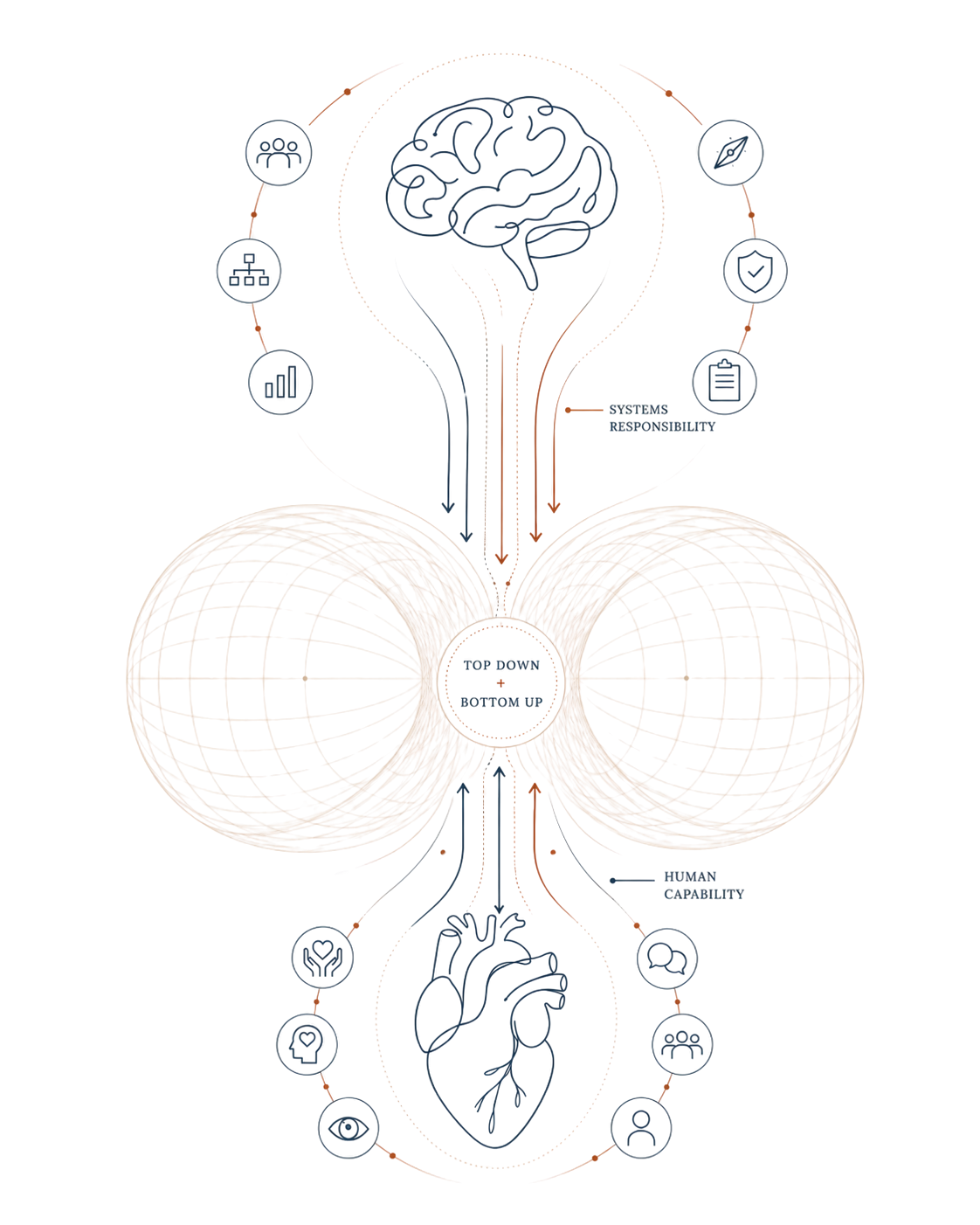
The Human Impact model
Systems responsibility
Organisation creates good systems, work design, leadership and controls.
Human capability
Individuals build self-awareness, personal leadership, communication and response capacity.
That is the Human Impact difference.

WHAT WE BUILD
Human Impact develops practical capabilities that strengthen how people recognise their state, think under pressure, communicate with others and take greater responsibility for the response they bring to work. Together, they support safer decisions, stronger relationships, better wellbeing and more resilient workplace cultures.
Workforce Capability
01 / 08
Capability 01
Recognise when stress, fatigue, emotion or distraction are beginning to influence communication and behaviour.
AWARENESS PRECEDES CHANGE
What we become aware of, we can begin to change.
OUR WORK
Different workplaces need different entry points. Human Impact can begin with a keynote, deepen through facilitated learning, or become an embedded workforce capability over time.
KEYNOTES & PRESENTATIONS
Workplace programs
Designed for frontline teams, supervisors, leaders, safety teams and operational workforces to understand how stress, emotional state, beliefs, perception and reactivity influence personal wellbeing, safety, culture and performance.
Enquire about trainingIncreasing employee and leadership confidence to recognise, approach and support someone experiencing a mental-health problem or crisis, and connect them with appropriate professional help.
Explore MHFA trainingA scalable internal capability model designed to help organisations sustain the language, tools and practices introduced through Human Impact training.
Enquire about ambassadorsTHE EVERYDAY MOMENTS
Culture is built beyond the training room in the moments no policy can script.
Workshops + microlearning
Workplace microlearning
We understand it isn't always operationally possible to take an entire workforce through facilitated training. Our short-form digital learning makes key concepts accessible across distributed teams, helping reinforce learning between sessions and extend development opportunities across the wider workforce.
Mining + remote workforces
Remote work creates a continuous exchange between life onsite and life at home. People can arrive carrying relationship strain, family responsibilities, financial pressure and disrupted routines. Fatigue, stress, isolation and difficult interactions can travel home.
These experiences shape how people reconnect, recover and the state they bring back to work.
For remote workforces, wellbeing isn’t confined to either side of the roster. The two environments continually influence one another.
DIGITAL WORKFORCE SUPPORT
Home Away From Home digital learning hub
Home Away From Home is a self-led digital program designed to support employees through the common personal challenges of FIFO and remote work, with selected resources also available to partners and families at home.
The program helps people build healthier routines around roster life, manage stress and isolation, stay connected with the people who matter, transition home more effectively and protect the recovery that influences how they return to work.
Book a call to discuss your workforceResearch insight
Emerging research in Australian mining highlights the interaction between personal emotional load and workplace conditions, raising an important question for safety systems:
Who is encountering the hazard today — and what capacity do they have available?
The 2025 whitepaper Psychosocial Safety: Refocusing the Lens — What Workers Bring Through the Gate identified a critical insight within Australian mining operations.
How we work
Every workplace has a different workforce, operating context and set of pressures. We start there, then design the right combination of speaking, training, workshops, digital learning and internal capability around the outcomes you’re trying to influence.
01
Understand the workforce and problem.
02
Select the right combination of speaking, workshops, training and resources.
03
Build understanding and practical capability.
04
Reinforce through microlearning, Ambassadors and ongoing implementation.
WHY WELLBEING MATTERS
Research consistently links employees' perception that their organisation cares about their wellbeing with outcomes including engagement, retention and organisational commitment.

Workplace research
The Human Impact Research Library brings together peer-reviewed research across psychosocial safety, stress physiology, perception, leadership, emotional regulation and workplace mental health — searchable by topic and evidence grade.
Articles
A worker walks through the gate after barely sleeping. The workplace didn't suddenly become more hazardous, but the human being encountering it wasn't in the same state they were yesterday.
A school leader hears it from a teacher. A physiotherapist hears it from a patient. A supervisor hears it at the end of a pre-start. The natural response is to treat it as a statement about ability, and most of the time that is not what it is.
There is someone on most sites who has been doing this for twenty years. When someone new struggles, he tells them it gets easier, and he says it kindly because he believes it. Much of the way experienced shift workers are rostered assumes he is right.
Tell us what you're seeing across safety, culture, wellbeing or performance and we'll explore what capability may be missing.